The Real Diamond Masterclass
Part 2 of 7
The practice of self-care and what does it entail? Let’s talk about it from a therapeutic perspective.
Cultivating a self-compassionate mind
How to rewire the brain and reverse your perception of who you are
Module two: Interrupting Unhealthy Patterns — Responding to Triggers with Clarity and Self-Trust
In the previous section, we explored how to reconstruct insecure attachment patterns and develop a stronger sense of self-worth.
In this section, our focus shifts toward developing an interdependent and genuine personality to support further personal growth. Note: The video adjacent to this module will help illustrate why cultivating self-compassion is essential for developing a secure and interdependent attachment style. It shows how practicing self-care and setting healthy boundaries directly transforms relational patterns, making it easier to break cycles of dependency and respond to relationships with authenticity and confidence. Watching this video will provide context for the exercises in this module and make the concepts more tangible.
Cultivating a Self-Compassionate Mind
Developing an interdependent and genuine personality begins with practicing self-compassion. Self-compassion creates inner safety, enabling honest self-reflection and sustainable change. It allows us to notice old patterns, understand triggers, and experiment with healthier behaviours without fear or shame.
This module guides participants to align personal goals with responsibility toward their community, express needs authentically, and maintain space for both self and others. Practicing skills such as articulating needs, managing frustration, connecting with emotions, and prioritizing self-care supports others without compromising well-being. In essence, self-compassion transforms old survival patterns into conscious, empowering choices, enabling clarity, self-trust, and a balanced, authentic personality.
1. Overview
This module supports women in recognising and interrupting learned relational patterns that lead to self-doubt, over-accommodation, or emotional reactivity in the face of triggers or controlling behaviours. These patterns often emerge from earlier relational experiences where emotional safety, autonomy, or personal needs were inconsistently protected.
When the nervous system perceives threat—through subtle pressure, withdrawal, manipulation, or disapproval—it activates automatic survival responses. These may include compliance, self-blame, emotional withdrawal, or urgency to restore harmony.
This module teaches participants to slow down automatic reactions by developing two essential internal capacities: mindful awareness and self-compassion. Together, these skills allow participants to remain emotionally present without abandoning themselves, creating space for conscious, values-aligned responding instead of automatic survival-based reacting.
Over time, this process restores emotional stability, strengthens self-trust, and supports personal autonomy in relationships.
2. Learning Outcomes
By the end of this module, participants will be able to:
- Recognise emotional triggers and early signs of controlling or manipulative behaviours
- Understand how learned relational patterns influence automatic reactions
- Pause and regulate emotional activation using mindful awareness
- Respond to internal experiences with self-compassion rather than self-criticism
- Set and maintain clear interpersonal boundaries while remaining emotionally grounded
- Respond consciously and intentionally, rather than from fear, guilt, or obligation
- Strengthen autonomy, emotional stability, and trust in internal guidance
3. Understanding Triggers and Learned Survival Patterns
Triggers are emotional activations that arise when present experiences echo earlier relational situations associated with loss of safety, control, or security. [Flow improvement: shorter, more direct.]
These triggers are not personal weakness; they reflect learned nervous system responses meant to preserve connection, reduce conflict, or prevent emotional harm.
Common triggering behaviours from others include:
- Withdrawal of attention, affection, or approval
- Subtle pressure, expectations, or demands
- Dismissal, minimisation, or questioning of choices
- Guilt-inducing statements or emotional manipulation
- Attempts to override preferences or autonomy
When triggered, the nervous system may produce anxiety, urgency, muscle tension, or emotional distress. These sensations are signals, not commands. This module teaches participants to interpret these signals accurately and respond in ways that protect well-being rather than reinforce old patterns.
4. The Role of Mindfulness: Creating Space Between Trigger and Response
Mindfulness strengthens the ability to notice emotional activation without immediate reaction, creating a critical psychological space between stimulus and response.
Participants will learn to:
- Pause and interrupt automatic reactions
- Observe emotional and bodily sensations without judgment
- Identify internal responses such as fear, guilt, urgency, or self-blame
- Recognise impulses to over-accommodate, argue, withdraw, or appease
This pause allows the nervous system to settle, restoring access to clear thinking and intentional decision-making.
Without this pause, behaviour is driven by learned survival patterns. With mindful awareness, behaviour aligns with present-moment clarity and personal values.
5. Self-Compassion as the Foundation of Emotional Stability and Autonomy
Self-compassion is the ability to respond to internal experiences with understanding, patience, and care, particularly during emotional activation. Instead of self-criticism or forced action, self-compassion allows participants to remain internally supportive while emotions naturally settle.
Self-compassion strengthens three core psychological capacities:
- Emotional stability: Emotional discomfort can be tolerated safely without immediate action
- Self-trust: Confidence in remaining present with emotional activation without abandoning personal needs
- Conscious responding: Decisions are guided by values, boundaries, and clarity rather than fear or obligation
Autonomy is not the absence of discomfort—it is the ability to remain connected to oneself while discomfort exists, responding intentionally rather than automatically.
6. How Mindfulness and Self-Compassion Work Together
Mindfulness and self-compassion create a stabilising internal system:
- Mindfulness: notice internal activation
- Self-compassion: remain present without self-abandonment
- Outcome: reduced threat activation and restored clarity
- Result: conscious, self-protective, values-aligned responses
Repeated practice weakens automatic survival responses and strengthens patterns rooted in self-respect, emotional stability, and autonomy.
7. Reflective Exercises
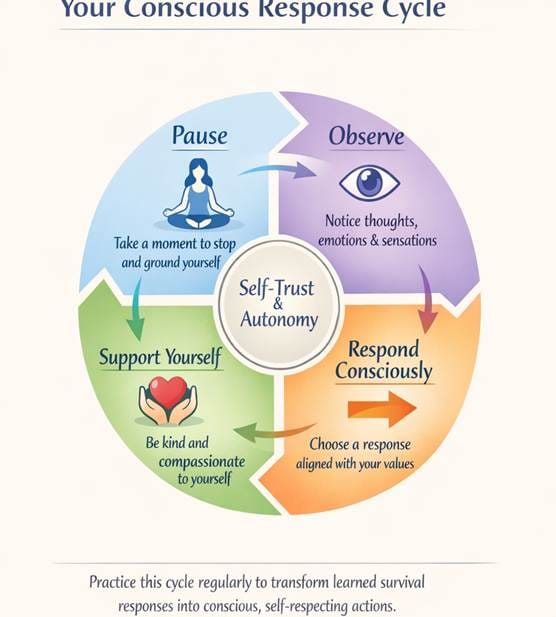
The Pause–Observe–Support–Respond Process
- Pause: Notice bodily sensations during triggers. Take slow, grounding breaths before responding
- Observe: Attend to thoughts, emotions, and sensations without judgment
- Support Yourself: Apply self-compassion and validate emotional experiences
- Respond Consciously: Act in alignment with values, well-being, and boundaries
- Reflect and Strengthen Self-Trust: Review the interaction to reinforce internal trust
Reversing Learned Patterns and Restoring Self-Trust
Participants practice real-world scenarios to interrupt automatic patterns such as over-accommodation or self-sacrifice. Exercises support:
- Recognising limiting self-beliefs
- Replacing fear-based beliefs with self-respecting perspectives
- Reducing anxiety, urgency, and emotional reactivity
- Communicating needs clearly
- Maintaining emotional presence without sacrificing autonomy
Strengthening Conscious Responding
Guided exercises help participants:
- Identify personal triggers and learned patterns
- Practice mindful awareness and emotional regulation
- Apply self-compassion during activation
- Respond aligned with values and wellbeing
- Strengthen emotional resilience and boundary clarity
Consistent practice develops internal steadiness, even amidst challenging relational dynamics.
Outcome: Restoring Autonomy and Emotional Freedom
Integration of mindfulness and self-compassion produces key shifts:
- Emotional activation becomes manageable
- Self-criticism replaced with internal support
- Trust in internal signals is restored
- Boundary-setting becomes clearer
- Behaviour guided by values rather than fear or obligation
Participants transition from reactive survival patterns to intentional, self-respecting engagement in relationships. Autonomy is restored through internal grounding, not control of others.
Case Studies
Emma: Reclaiming Autonomy
Emma’s partner subtly assumed control, creating tension and urgency in her nervous system. Through mindful pausing, self-compassion, and reflective awareness, she learned to:
- Recognise emotional activation as signals, not commands
- Respond without self-abandonment
- Identify and revise limiting beliefs
- Set boundaries while maintaining connection
- Strengthen autonomy and emotional stability
Sarah: Recovery from Coercive Control
After leaving a controlling relationship, Sarah experienced residual anxiety and self-doubt. Through mindfulness and self-compassion, she rebuilt:
- Internal safety and trust
- Confidence in independent decision-making
- Emotional stability
- Boundary clarity
- Capacity for self-directed relational engagement
Both case studies illustrate that learned survival responses are reversible, and internal authority can be restored even after relational trauma.
Module Summary
Participants gain practical skills to interrupt unhealthy relational patterns, respond to triggers and controlling behaviours with clarity, self-trust, and emotional stability, and restore autonomy. Mindfulness and self-compassion enable them to protect boundaries, honour needs, and respond from values, fostering healthier, balanced, and self-respecting relationships.